We Can Still Hear You, Antigone: A Reflection
By Melvin Ningyao Yen
Some stories don’t stay in the syllabus. They start as assigned reading—then, years later, you realize they follow you—quietly, stubbornly—into adulthood. Antigone is one of them. A girl at the edge of the city. A law that claims it’s older than mercy. A body treated as public territory.
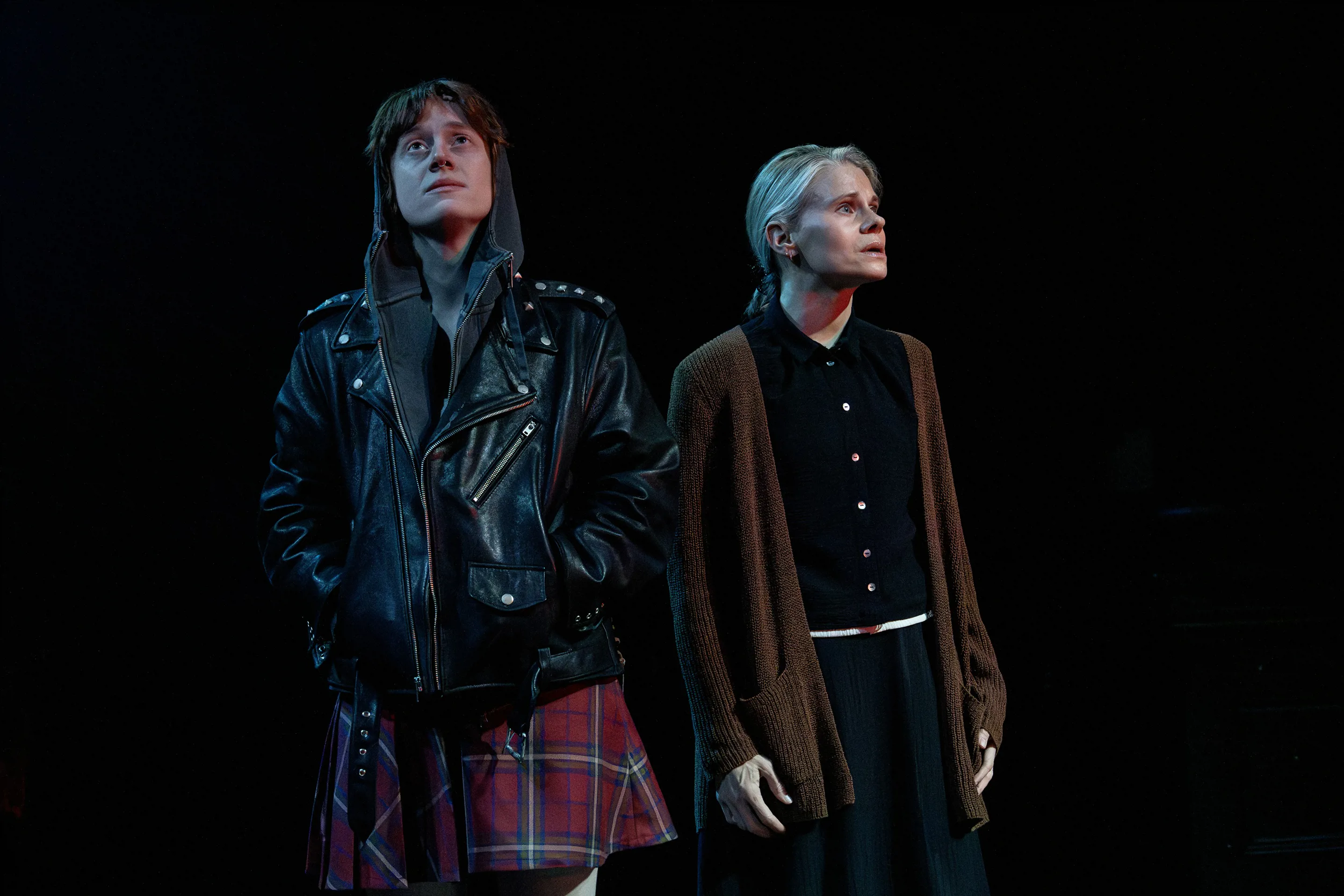
Anna Ziegler makes that “following” literal. Celia Keenan-Bolger plays the Chorus—embodied here as Dicey, a present-day woman. In Greek tragedy, that chorus is often a council of traditionally male elders standing in for the city: speaking, judging, mourning. Here, that civic voice lives in a woman’s body, so the “city” is no longer outside the action—it’s inside the very body under debate.
On a flight into Pittsburgh, Dicey notices the play Antigone “in the twitchy hands of a teenager whose red pen storms over every page.” Dicey tries to speak the way she always speaks: “I’m sorry,” she says—because, as she admits, “the only way I can start a conversation is to apologize for my entire existence.” And then, the teenager looks up and asks the question that strikes like a match being struck: “Is it even about her? It seems like it’s all about her brother’s body. A man’s body.” Something in Dicey flinches awake. That’s where this version begins: to recenter the tragedy on Antigone.
That question—Is it even about her? —is the hinge of Ziegler’s ANTIGONE (THIS PLAY I READ IN HIGH SCHOOL). The play, now running at The Public Theater until April 5 under Tyne Rafaeli’s direction, keeps the bones of that myth but grafts on a second life. The story runs on two timelines—Thebes and Pittsburgh—but the present is not a separate side plot. Introducing Dicey insists that the myth is still alive.
If you haven’t met Antigone before, here’s a bit of "Antigone 101": Antigone, daughter of Oedipus, lives in Thebes. After her two brothers’ civil war leaves them both dead, Creon (Tony Shalhoub), the new ruler, buries one brother as a hero and leaves the other unburied as a traitor. Antigone buries her brother against the king’s decree. In Sophocles that act sets the tragedy in motion: Antigone is arrested. In this version, the city doesn’t stop at her brother’s body. It turns to Antigone’s.
In Thebes, Susannah Perkins’ Antigone becomes pregnant before her marriage to Creon’s son, Haemon (Calvin Leon Smith)—and in this city of secrets and surveillance, that fact does not stay hidden for long. Antigone’s sister, Ismene, (Haley Wong) tries to make the pregnancy survivable by making it about logistics: “So we’ll move up the wedding.” In one breath, you can feel a body becoming a narrative the city will try to police.
Dicey isn’t “a narrator” in the usual sense. Here, Ziegler offers us a Chorus with a singular face, name, life. We meet her first as a teenager assigned Antigone, bristling at the page, arguing back at it. Years later, the play brings her forward into adulthood and gives her a body with its own deadlines: she is pregnant now, carrying a life that measures time whether she wants it to or not. She says she “feels time passing in her body… has made of her body a clock.” It’s because of a due date, a heartbeat, a calendar you cannot negotiate with—time turning from something you read about into something you physically keep.
And then the play makes the clock audible. “There’s a pain in her side that won’t go away.” Dicey doesn’t interpret it. She acts. She calls a taxi and goes straight to the hospital. Thisis Dicey’s story: a contemporary life becoming porous, the membrane between reading and living thinning until the myth stops behaving like an assignment and starts behaving like an emergency. The title says what Dicey lives: this is the play she read in high school—and the play that won’t stay there. And because Antigone is also pregnant in this version of the story, Dicey doesn’t just “understand” Antigone; she recognizes her, body-first. The myth returns as bodily knowledge—something she can’t outthink, only carry.
From there, with the chorus embodied in Dicey, the city answers back in choruses too. The production doesn’t ask you to “understand” power; it stages how it moves. You can hear it in the cops, (Katie Kreisler, Dave Quay, and Ethan Dubin) and Rafaeli drives them like a mini‑chorus of enforcement: overlapping lines, shared rhythm, certainty assembled in public. When Creon presses them, asking who is actually reporting this, they offer the new logic of proof: “It’s all more crowd-sourced,” which is how you get “up to the minute reporting,” though, they admit, “you lose a fair bit of accuracy.” They trace the rumor back through “my wife’s sister’s Pilates instructor” and “who was chatting with her Uber driver” until their "truth" is revealed: Antigone was spotted at “an abortion clinic.”
Creon’s response is immediate. Flat. Administrative. “Well, those aren’t allowed anymore. Shut it down.” A right becomes illegal at the speed of a sentence; care becomes contraband because authority says so.
Ziegler refuses to let the consequence stay abstract. The bodily cost is spoken out loud. When Antigone clings to the old faith that women will “find a way,” Ismene answers with the date-stamp of the new world: “As of today, the ways are all blocked. The river is dammed.” And then she says what that dam means for a woman's body: “Suddenly you could be bleeding out… or they could perforate your uterus and you’d die from sepsis.” "Even if you survive," she says, "you still have Creon to contend with, because he will find out."
In this play, you can hear biopower: the power that rules by controlling what care is available and what happens to you when you try to reach it. Here, the state gets to decide what counts as “care” and what becomes contraband. You can hear it in Creon’s flat directive to “shut it down,” and in how a “crowd-sourced” rumor is made usable—then, when Antigone returns from the clinic, made actionable—while the body bears the aftermath.
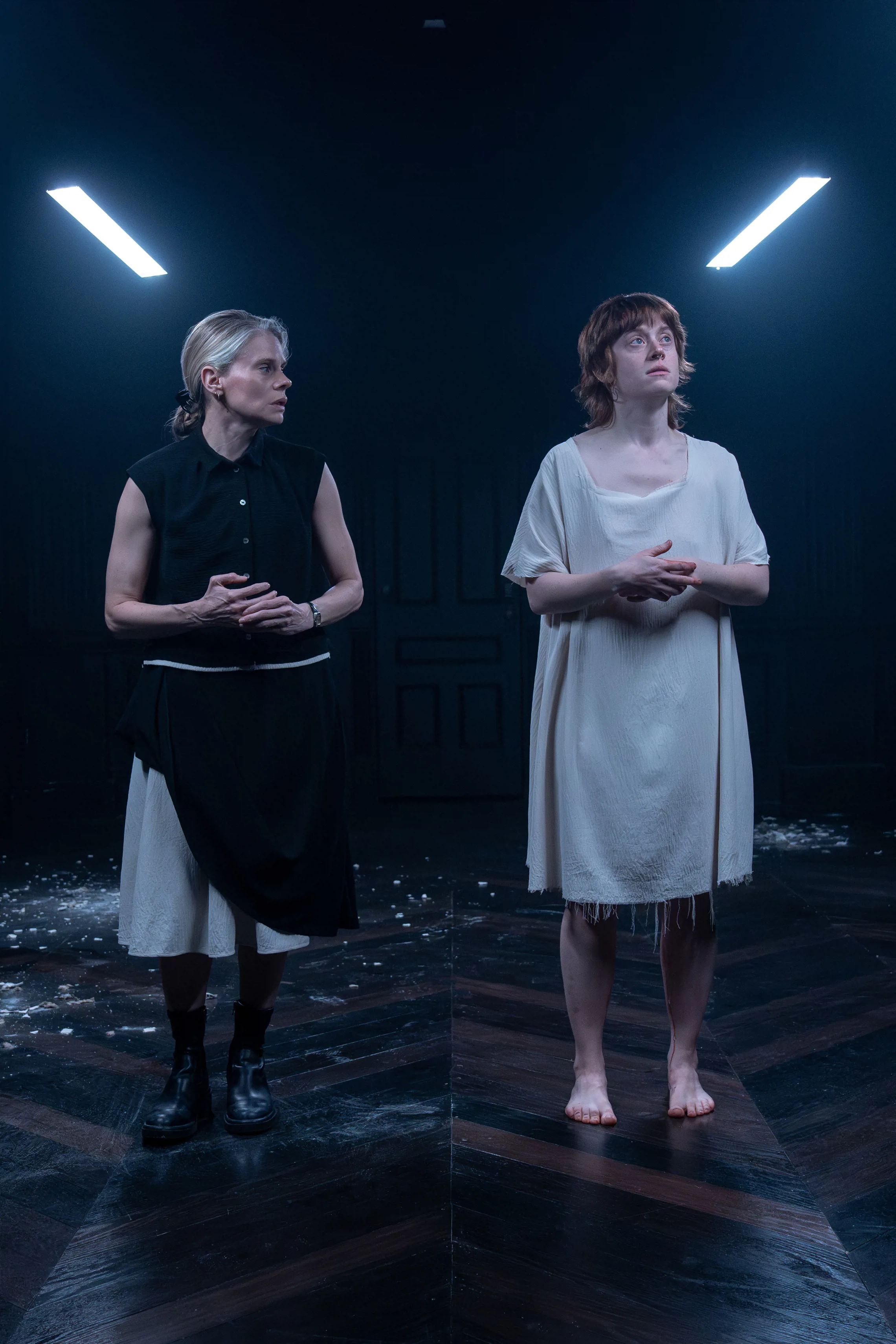
Rafaeli’s staging makes that overlap legible. Near the end, Dicey’s hospital and Antigone’s prison share the same air—four cold light bars frame the space. Dicey is in labor— “Dicey pushes”—and the play names what she is pushing against: “history and legacy and inheritances of silence.” Antigone is there too, refusing and trembling in the same rhythm. The worlds aren’t the same room, but they touch closely enough that care and custody begin to rhyme.
Care and custody begin to rhyme is a hard sentence to write, because it can sound like inspiration when it is actually desperation. The body becomes the last place where choice can still occur even when choice is punishable, even when the law tries.
And then the ending arrives, and something ancient opens—not as romance, but as pressure. Antigone looks at Dicey with a kind of delighted recognition: “It’s my voice. Isn’t it. It’s inside you.” Dicey answers, simply: “I can hear you.” And then the line that makes everything earlier—every “I’m sorry,” every swallowed sentence—snap into place: Dicey thanks her for not apologizing. The recognition doesn’t stay in the head. Dicey and Antigone look at each other and then scream together, in relief and release.
This is the stake of the whole piece. We can still hear Antigone because Dicey is there to keep the channel open—because through her, the play lets a lineage of women speak in the present tense, and because the play refuses to let the chorus remain a historical form. It gives the chorus a life, a body, a present tense. It says: this voice is not a relic. It is a recurrence.
And when Antigone turns outward—“TO ALL THE PEOPLE OF ALL THE WORLD, KNOW THIS: I MADE A CHOICE”—the moment does not read like easy victory. It reads as clarity: a decision spoken out loud in a world determined to translate women into evidence.
I found myself holding a wish as the play moved toward its last breath: that every woman could reach that altitude, that place where she can speak without being turned into report, rumor, cautionary tale.
This is why this production matters now. We live after Dobbs—after June 24, 2022, when abortion rights were handed back to state lines and local enforcement. The border between care and control keeps sliding. We are not outside this story, safely observing. The voice returns, again and again, until we are willing to face it.
If we need anything now, it is a theatre that keeps the channel open. This play does.
We can still hear you, Antigone.

ANTIGONE (THIS PLAY I READ IN HIGH SCHOOL) began performances on Thursday, February 26 and runs through Sunday, April 5. Click here for more information on the show and how to get tickets.
Melvin Ningyao Yen (all pronouns) is a New York–based Taiwanese theatre producer, director, playwright, and cultural critic. Growing up in a Buddhist family, their work often weaves the philosophy of impermanence into performance. Their artistic practice bridges theatre, photography, and academic writing, with recent research on Embodied Semiosis in Global Physical Theatre. Melvin has held fellowships at Playwrights Horizons and Manhattan Theatre Club, and their works include the musical Awake and plays such as The Flight of Impermanence, Breakfast, and Waning Moon. They publish theatre criticism, poetry, and essays on their Substack, The Ritual of Seeing. Instagram: @melvindoesntknow
This piece was developed with the BIPOC Critics Lab, a new program founded by Jose Solís training the next generation of BIPOC journalists.